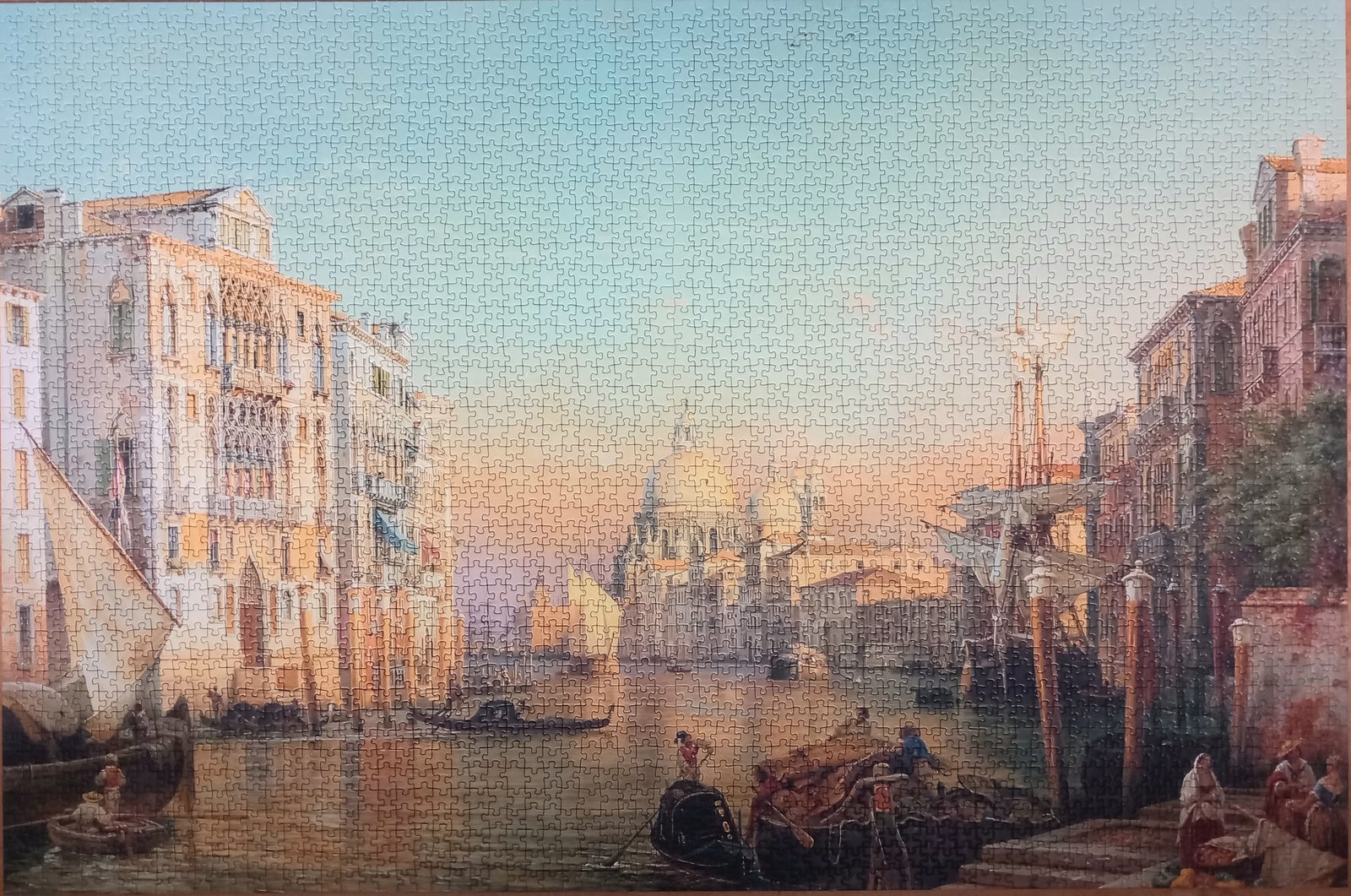
Langlois Bridge

From Darin's Collection
Puzzle enthusiast and collector
3000 Ravensburger (80 x 121)
Langlois Bridge
Vincent van Gogh
Production Date 2015
I did this during a school holiday in 2019. It's a stunning puzzle and was not as difficult as it seemed.
Vincent van Gogh's The Langlois Bridge at Arles was painted in March–May 1888, shortly after Van Gogh arrived in Arles in southern France. The painting depicts a wooden drawbridge over the Arles–Boulevard canal, with a small group of figures and a horse-drawn cart nearby. The bright blue sky, yellow-orange earth, and intensely colored vegetation demonstrate Van Gogh's rapidly developing use of bold, complementary colors.
Van Gogh was fascinated by the bridge because of its combination of Japanese-inspired simplicity and Provençal landscape. The strong horizontal and vertical lines of the bridge, canal, trees and distant buildings give the composition a carefully structured, almost graphic quality. He painted several versions of the subject, including paintings in which women are shown washing clothes beside the canal, as well as drawings and watercolors.
One of the best-known versions, painted in oil on canvas, 54 × 65 cm, is in the Kröller-Müller Museum in Otterlo, Netherlands. The museum's version is generally dated 1888 and is sometimes referred to as The Langlois Bridge with Women Washing. The original bridge itself was demolished in the 1930s.
Langlois Bridge
Vincent van Gogh
Production Date 2015
I did this during a school holiday in 2019. It's a stunning puzzle and was not as difficult as it seemed.
Vincent van Gogh's The Langlois Bridge at Arles was painted in March–May 1888, shortly after Van Gogh arrived in Arles in southern France. The painting depicts a wooden drawbridge over the Arles–Boulevard canal, with a small group of figures and a horse-drawn cart nearby. The bright blue sky, yellow-orange earth, and intensely colored vegetation demonstrate Van Gogh's rapidly developing use of bold, complementary colors.
Van Gogh was fascinated by the bridge because of its combination of Japanese-inspired simplicity and Provençal landscape. The strong horizontal and vertical lines of the bridge, canal, trees and distant buildings give the composition a carefully structured, almost graphic quality. He painted several versions of the subject, including paintings in which women are shown washing clothes beside the canal, as well as drawings and watercolors.
One of the best-known versions, painted in oil on canvas, 54 × 65 cm, is in the Kröller-Müller Museum in Otterlo, Netherlands. The museum's version is generally dated 1888 and is sometimes referred to as The Langlois Bridge with Women Washing. The original bridge itself was demolished in the 1930s.