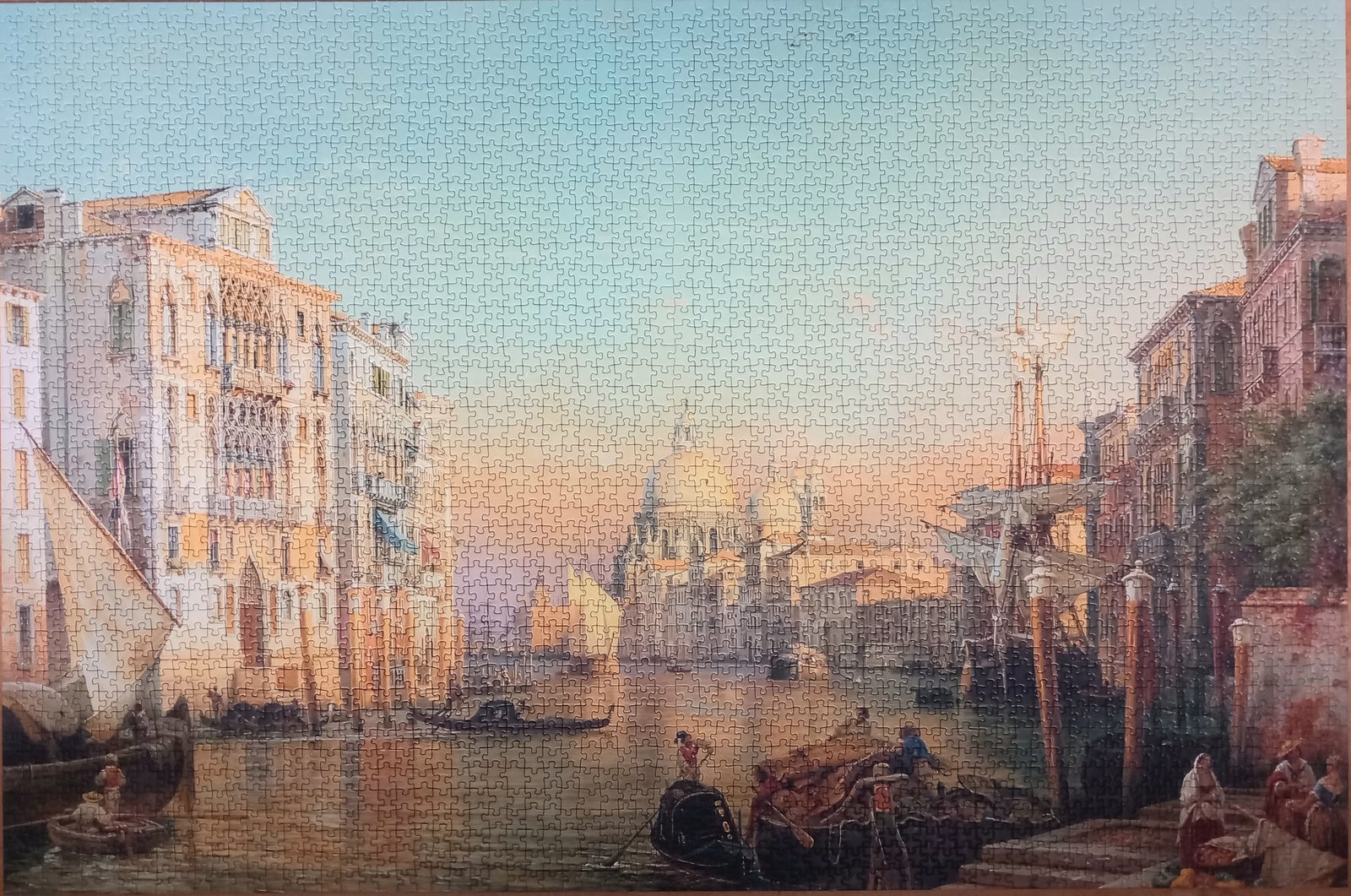
At the Sweet Waters of Asia in Constantinople
From Darin's Collection
Puzzle enthusiast and collector
3000 Ravensburger (80 x 121)
At the Sweet Waters of Asia in Constantinople
Johann Michael Wittmer
Production Date 1973
This is one of my favorite old Ravensburger puzzles. I love Orientalist works and Istanbul is one of my favorite cities as well. The bottom half was pretty easy, but the trees were extremely difficult. This is a used copy and a few pieces were repaired by the previous owner.
At the Sweet Waters of Asia in Constantinople is an 1837 Orientalist painting by the German artist Johann Michael Wittmer (1802–1880). The original is approximately 118.6 × 80.7 cm and belongs to the Neue Pinakothek / Bavarian State Painting Collections in Munich.
The painting depicts one of the celebrated recreational areas on the Asian side of Constantinople, traditionally known as the Sweet Waters of Asia. These pleasant waterside locations on the outskirts of Ottoman Istanbul were popular gathering places where people came to socialize, picnic, ride horses, listen to music and enjoy the countryside away from the crowded city.
Wittmer's composition is therefore less an architectural view of Constantinople than a panoramic Orientalist genre scene. The foreground is populated by groups of Ottoman-era figures engaged in leisure and conversation, with men and women in colorful traditional dress, horses and other details scattered through the landscape. A horse and riders are particularly prominent, while the numerous figures give the scene the character of a public festival or outdoor gathering. The work is sometimes described in European collections simply as an Oriental Folk Scene.
The landscape is equally important. Wittmer creates a lush setting of large trees, green vegetation and open ground surrounding the water, contrasting the relaxed natural environment with the elaborate costumes of the people. The trees occupy much of the upper part of the composition and create a shaded canopy beneath which the groups have gathered. This produces a strong sense of depth, with the eye moving from the foreground figures through the middle-distance groups and into the wooded landscape beyond.
At the Sweet Waters of Asia in Constantinople
Johann Michael Wittmer
Production Date 1973
This is one of my favorite old Ravensburger puzzles. I love Orientalist works and Istanbul is one of my favorite cities as well. The bottom half was pretty easy, but the trees were extremely difficult. This is a used copy and a few pieces were repaired by the previous owner.
At the Sweet Waters of Asia in Constantinople is an 1837 Orientalist painting by the German artist Johann Michael Wittmer (1802–1880). The original is approximately 118.6 × 80.7 cm and belongs to the Neue Pinakothek / Bavarian State Painting Collections in Munich.
The painting depicts one of the celebrated recreational areas on the Asian side of Constantinople, traditionally known as the Sweet Waters of Asia. These pleasant waterside locations on the outskirts of Ottoman Istanbul were popular gathering places where people came to socialize, picnic, ride horses, listen to music and enjoy the countryside away from the crowded city.
Wittmer's composition is therefore less an architectural view of Constantinople than a panoramic Orientalist genre scene. The foreground is populated by groups of Ottoman-era figures engaged in leisure and conversation, with men and women in colorful traditional dress, horses and other details scattered through the landscape. A horse and riders are particularly prominent, while the numerous figures give the scene the character of a public festival or outdoor gathering. The work is sometimes described in European collections simply as an Oriental Folk Scene.
The landscape is equally important. Wittmer creates a lush setting of large trees, green vegetation and open ground surrounding the water, contrasting the relaxed natural environment with the elaborate costumes of the people. The trees occupy much of the upper part of the composition and create a shaded canopy beneath which the groups have gathered. This produces a strong sense of depth, with the eye moving from the foreground figures through the middle-distance groups and into the wooded landscape beyond.