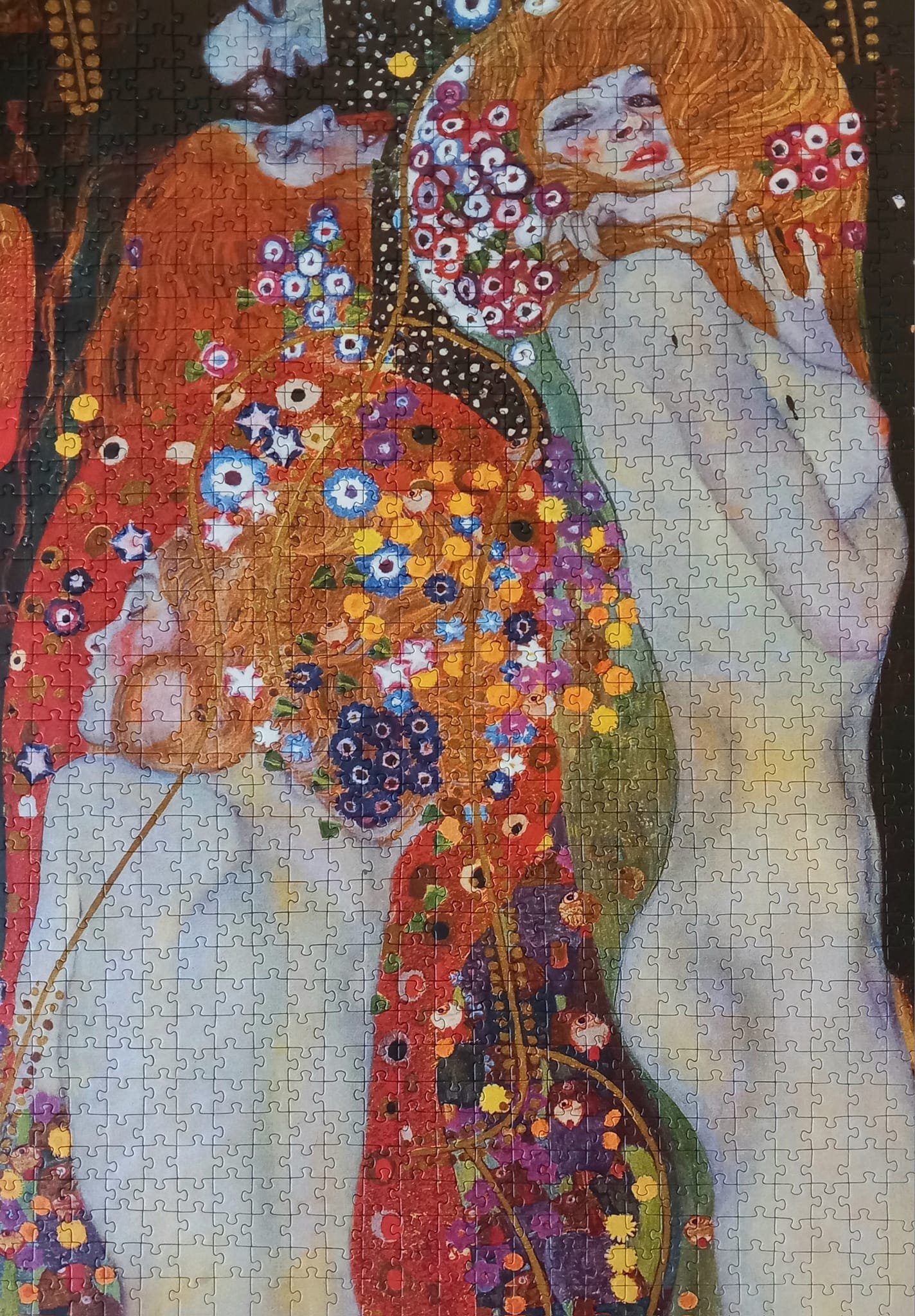
The Dancer

From Darin's Collection
Puzzle enthusiast and collector
1000 Bluebird (48 x 68.3)
The Dancer, 1918
Gustav Klimt
Production Date 2022
I did this puzzle on breaks from the garden at our village home. It was fun to build, but much more difficult than I had expected.
The Dancer, painted by Gustav Klimt between 1916 and 1918, is one of the artist's final and most richly decorative works. The painting depicts a young dancer in an exotic, loosely draped costume, holding a small bouquet of yellow flowers against a spectacular background of blossoms, foliage and intricate patterns. Klimt deliberately dissolves the distinction between figure and surroundings: the woman's clothing, the floral motifs behind her and the decorative surface of the painting seem to merge into a single ornamental tapestry. The work reflects Klimt's late fascination with Asian and Oriental decorative motifs, while retaining his characteristic emphasis on the female figure. The painting was still unfinished when Klimt died in February 1918, with the lower portion of the canvas and parts of the preliminary drawing remaining incomplete. The identity of the model and the painting's relationship to Klimt's posthumous portraits of Ria Munk have been the subject of considerable scholarly discussion.
The Dancer, 1918
Gustav Klimt
Production Date 2022
I did this puzzle on breaks from the garden at our village home. It was fun to build, but much more difficult than I had expected.
The Dancer, painted by Gustav Klimt between 1916 and 1918, is one of the artist's final and most richly decorative works. The painting depicts a young dancer in an exotic, loosely draped costume, holding a small bouquet of yellow flowers against a spectacular background of blossoms, foliage and intricate patterns. Klimt deliberately dissolves the distinction between figure and surroundings: the woman's clothing, the floral motifs behind her and the decorative surface of the painting seem to merge into a single ornamental tapestry. The work reflects Klimt's late fascination with Asian and Oriental decorative motifs, while retaining his characteristic emphasis on the female figure. The painting was still unfinished when Klimt died in February 1918, with the lower portion of the canvas and parts of the preliminary drawing remaining incomplete. The identity of the model and the painting's relationship to Klimt's posthumous portraits of Ria Munk have been the subject of considerable scholarly discussion.